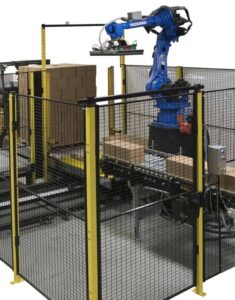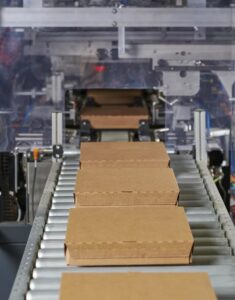

Labor challenges are reshaping packaging operations across manufacturing, food production, and distribution. Finding and retaining workers for repetitive end-of-line tasks like case sealing, palletizing, and packing is becoming more difficult, especially in high-volume environments.
For many operations, the question is no longer whether labor is a constraint. It is how to reduce dependency on it without sacrificing throughput, consistency, or service levels.
The Limits of a Labor-Driven Packaging Model
When demand increases, the most common response is to add labor. It works in the short term, but it rarely scales efficiently.
Over time, a labor-heavy model introduces friction across the operation. Performance becomes harder to manage, and costs rise alongside volume instead of stabilizing.
Common challenges include:
- Rising labor costs tied directly to output
- Increased training requirements and onboarding time
- Inconsistent performance across shifts and teams
- Higher exposure to turnover and absenteeism
In high-throughput environments, these issues can quickly impact packaging line efficiency, uptime, and overall operational reliability.
Stabilizing Throughput with Packaging Automation
Automation offers a more stable and scalable approach to end-of-line packaging.
By reducing reliance on manual processes, operations can create more consistent workflows that are less dependent on staffing levels. Tasks like case sealing, palletizing, and packing become standardized, improving both speed and repeatability.
Instead of performance varying by shift, output becomes more predictable.
This shift helps operations:
- Maintain throughput during labor shortages
- Improve consistency in packing and load quality
- Reduce downtime tied to manual intervention
- Create a more controlled and repeatable process
The result is not just efficiency. It is stability across the entire packaging line.
Refocusing the Workforce for Higher-Value Work
Reducing labor dependency does not mean removing people from the operation. It means changing how they contribute.
As repetitive tasks are automated, teams can shift toward roles that add more value to the business. That includes oversight, quality control, equipment optimization, and continuous improvement initiatives.
This creates a more balanced operation where people are focused on performance, not just output.
Automation allows packaging operations to move away from a model that depends on labor availability and toward one that is driven by systems, consistency, and long-term scalability.